
It is our only chance of avoiding a repeat of our catastrophic second wave, asserts Naushad Forbes.
Digital payments and financial services firm Paytm has filed a draft red herring prospectus for its proposed Rs 16,600-crore initial public offering (IPO) with the Securities and Exchange Board of India.

Modi's critics will say that he has put up cement and steel structures, but weakened the institutions of governance whereas Nehru strengthened them, observes T N Ninan.

"Yeh sab doglapan hai." With these words, Ashneer Grover not only called out an entrepreneur being hypocritical, but also shot to fame as a reality television star. It happened in the first few days of January, when the funded part of the start-up world needed some warm-up to get back to work, and inevitably Grover's antics on the show became a talking point. The Twitterati also debated whether it was unbecoming of a founder to diss a peer's business model with such abrasion. And hundreds of memes, with the dialogue set in various circumstances, flooded social media.
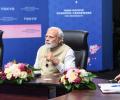
As US President Joe Biden launched a new trade deal with 12 Indo-Pacific nations, including India, to enhance trade, economic and investment opportunities, China, which sees the pact as a threat to its dominance in the region, went on the offensive against it, promising more opening up, while the official media here termed it as "economic Nato".

Byju's, says Anita Kishore, has given the founders of the businesses it has acquired the independence to operate separately and maintain their core culture.

For the first seven days, India's trajectory was close to that of the US and the UK, but the implementation of the lockdown from Day 8 seems to have helped us control the spread significantly despite our larger population.

With a team of 20-odd people, Snafu tries to unearth the rough diamonds from millions of songs. Can AI help look for a needle in a haystack? Ritwik Sharma finds out.
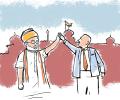
The footprints of Indian-origin corporate executives at multinationals is expanding, with Sandeep Kataria taking over the reins of footwear major Bata as its global chief executive officer. From FMCG majors to IT titans, Kataria joins the league of Indian-origin executives who have climbed the highest echelons of corporate across diverse sectors globally. From Nooyi to Pichai to Nadella, the list of such people at the helm of multi-billion dollar enterprises is long.

The 10 entrepreneurs are collectively worth $407.4 billion, accounting for about 20 per cent of the total ultra-rich wealth in America.

Walmart-owned Flipkart will undertake a buyback employee stock options worth about Rs 600 crore, according to sources Earlier in the day, Flipkart announced raising $3.6 billion (about Rs 26,805.6 crore) in funding from a clutch of investors that valued the e-commerce major at $37.6 billion (about Rs 2.79 lakh crore). In an e-mail to employees, Flipkart group chief executive officer Kalyan Krishnamurthy lauded the critical role played by the staff in reaching this milestone.
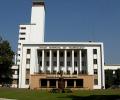
IIT Kharagpur gets more than 1,000 job offers in a record five days, with 144 companies visiting the campus till Dec 5

as journalists active in Pakistani media have been quick to point out, with Ghafoor at the helm in Balochistan, no one will take seriously any claims by the civilian leadership to use the velvet glove to work for peace there, points out Rana Banerji, who headed the Pakistan desk at the Research and Analysis Wing, India's external intelligence agency.He did not hesitate to pejorate developments in India at the slightest opportunity, points out Rana Banerji, who headed the Pakistan desk at the Research and Analysis Wing, India's external intelligence agency.

While three of the top five FPIs - Capital, Government of Singapore, and Vanguard - have seen their investment value more than triple, India's benchmark indices have risen just 70%.

TikTok has stressed that its US user data is already stored on US-based servers and backed up in Singapore, and is therefore not subject to Chinese law as some US officials have feared.

Digibank will offer only savings deposits initially, but will expand to include investments and lending in the coming months.
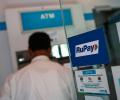
RuPay is working on how to increase offers to customers. It is also focused on technology innovation in the card payment system.

The all-cash transaction is likely to be complete in the first quarter of 2020, subject to regulatory clearance.
'The company's transition from an individuals-driven private firm to a board-driven listed public one will be carried out in a well-thought-through and well-executed manner.'

After multiple attempts at selling itself, including to larger e-commerce player Snapdeal, ShopClues has found a buyer in Singapore-based e-commerce platform Qoo10 in an all-stock deal.

Japan could soon be the second country after the US with which India has a logistics support agreement. Besides the LSA, India and Japan may also sign a maritime domain awareness agreement which would enable the two navies to share information. For example, if a Japanese P-1 maritime patrol aircraft detects a Chinese submarine in the Indian Ocean, it would pass on the information to the Indian Navy, reveals Ajai Shukla.

At 8 million a month, times two doses, it will take us 17 years to administer the vaccine to our 800 million adults. The rollout must speed up twenty times, asserts Naushad Forbes.

In the start-up world, hitting the $1-billion mark, which accords the "Unicorn" tag, is a milestone. Enterprises typically reach the milestone only by series C or series D, or three to four funding rounds later. Zeta achieved it at the first one. On May 25, the six-year-old banking tech firm raised $250 million from Japanese conglomerate SoftBank, at a post-money valuation of $1.45 billion. "This is the first time we have raised institutional money," Zeta co-founder Bhavin Turakhia beamed on the conference call. This trajectory is uncommon in start-ups.

Leveraging global capital markets to give muscle to an innate competitive advantage in rapid mass transaction systems will lead to India becoming a petri dish for global enterprises and new-age innovation that it yearns to be.

The Securities and Exchange Board of India (Sebi) has introduced an optional T+1 settlement cycle for the markets. T+1 means that settlements will have to be cleared within one day of the actual transactions taking place. The regulator has put the onus on the stock exchanges to decide whether they want to opt for the shorter settlement cycle for any of the listed scrips. This can be done after giving a one-month prior notice to all stakeholders.
The new rules will bring down people's mobility and as a result flexibility in scaling businesses

India's jugalbandhi with coal and clean energy is coming unstuck, neither achieving adequate renewable generation nor ensuring sufficient coal-fired power in the quest to become a $5-trillion economy. Six months have elapsed since Prime Minister Narendra Modi announced an ambitious climate agenda for India at COP26 at Glasgow. The net zero emissions target by 2070 is a distant one, but there are nearer-term plans to meet 50 per cent of energy demand with renewables by 2030 by increasing capacity to 450 Gw. A cursory look at the balance sheet of India's climate progress since November reveals ponderous progress towards meeting the renewables target even as the country is scrambling to expand coal-fired generation in the face of a power crisis.

The advent of artificial intelligence, blockchain technology and cryptocurrencies, and the increasing use of Internet of Things devices throw techno-legal challenges regarding privacy and security. Experts say, any expansion of power to the government to block web-services is detrimental to the interests of users, innovation, and India's larger technology ecosystem. The move to block the mobile apps is likely to have a lasting impact on the data security and privacy framework.

In another milestone for the DMRC, driverless train operations on 59-km Pink Line of the Delhi Metro were flagged off on Thursday.

The researchers said the growth rate of COVID-19 is weakly linked to the outdoor weather, adding that the chances of the survival of the virus "increases roughly by five times under a humid condition as compared to a dry condition."

Wrapped in blue and orange wax paper, it's a familiar sight on the shelves of kirana stores across the country. Given how well travelled and mobile it is - starting its journey in Chennai, then turning to Singapore and now landing in Mexico - you could say it lives up to its name: Modern. Modern Food Enterprises, the company that manufactures and sells the bread in question as well as other bakery products under the "Modern" brand name, has recently been sold to the world's largest baking company, Grupo Bimbo, for an undisclosed amount. This latest transaction is the second change of guard at Modern within five years and third since the government divested the company at the turn of the century. At a time, when the National Democratic Alliance government has decided to privatise, or shut down, public sector enterprises except for those deemed strategic, Modern makes for a promising case study of how divestment led to the brand's growth, both in revenue and reach.

In the year 2020 to date, these funds deployed capital worth a record $14.8 billion in India, which is nearly three times more than what they have put in China - $4.5 billion.

Most of the large Indian IT services players, such as TCS, Infosys, Wipro, and HCL Tech, have signalled increased offshoring efforts and opting for local hires in the US, primarily to address the immigration-related challenges.

Google Inc opened its first two data centres in Asia on Wednesday to cater to the world's fastest growing consumer technology markets, but the company has no plans to open one in China or India.
The turmoil in financial markets seems to be affecting the global expansion plans of Financial Technologies, promoter of top domestic commodity bourse MCX, and trading at its overseas exchange ventures in Singapore, Mauritius and Bahrain may get delayed by about a year.

India's e-commerce market is poised to grow by 84 per cent to $111 billion by 2024 on the back of accelerated adoption of digital technologies amid the COVID-19 pandemic, a report by fintech firm FIS said on Wednesday. The report noted that countries, including India, have seen a shift in consumer behaviour caused by COVID-19, and new payment trends are shown to be on the rise. FIS, in its 2021 Global Payments Report, examined current and future payment trends across 41 countries. India's e-commerce market is projected to grow by 84 per cent between now and 2024 to about $111 billion (from about $60 billion in 2020) driven by mobile shopping, which is projected to grow 21 per cent annually over the next four years, the report said.

'From the very start, PM Modi was insistent that visiting foreign leaders should be exposed to an India beyond its capital.' 'Through these experiences, he felt that the full Indian narrative would be much better understood across the world,' explains External Affairs Minister S Jaishankar. A riveting excerpt from Bluekraft Digital Foundation's Modi@20: Dreams Meet Delivery.

In India, many cities lack bicycle lanes and proper pavements. This, coupled with heavily congested roads, creates a danger to cyclists. Furthermore, the low costs of bicycles may make it more economical to buy than to rent.
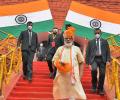
According to the details provided by Muraleedharan, the prime minister made five visits each to the United States, Russia and China, and multiple trips to some other countries like Singapore, Germany, France, Sri Lanka and the United Arab Emirates.

All directors, key officials, and shareholder speakers will be visible and audible and thousands of shareholders, including those from the US, UK, Canada UAE, Japan, HongKong, Singapore, Malaysia, and Australia, will be able to post their questions and eVote on resolutions.
